
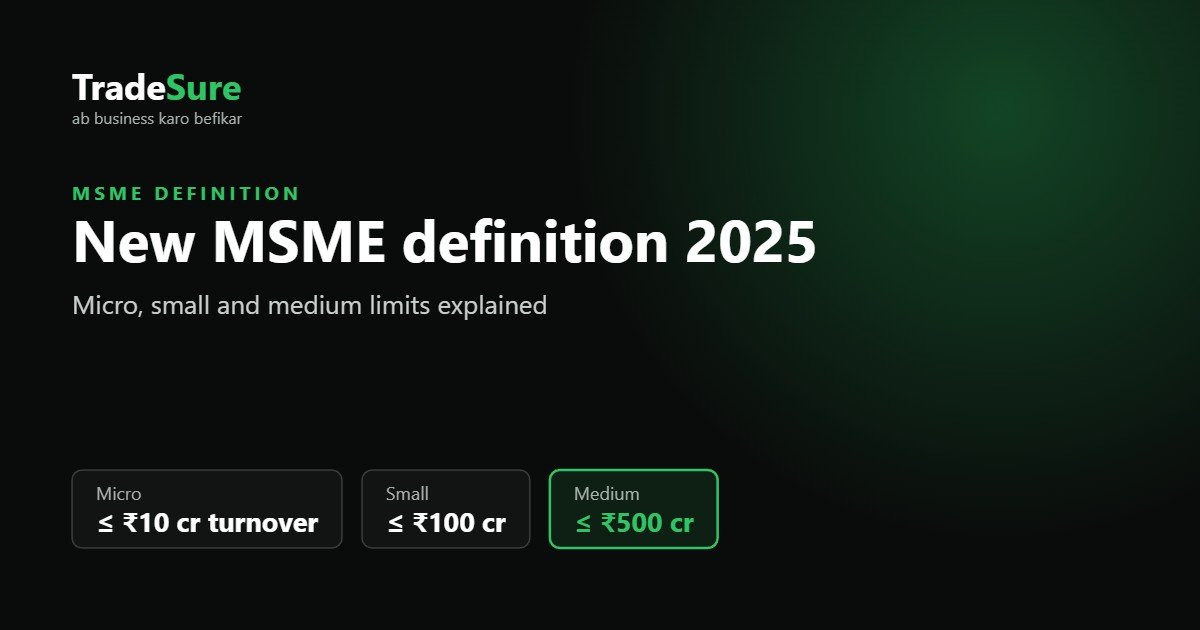
From 1 April 2025, an enterprise is micro if its investment in plant and machinery or equipment is up to ₹2.5 crore and its turnover is up to ₹10 crore. It is small up to ₹25 crore and ₹100 crore, and medium up to ₹125 crore and ₹500 crore. Both conditions must be met to stay in a category.
The government raised the investment limits 2.5 times and the turnover limits 2 times, through Notification S.O. 1364(E) dated 21 March 2025 (Taxmann). The aim was to let growing businesses keep MSME benefits for longer.
The new limits at a glance
| Category | Investment (plant & machinery / equipment) | Turnover | Old limits |
|---|---|---|---|
| Micro | Up to ₹2.5 crore | Up to ₹10 crore | ₹1 cr / ₹5 cr |
| Small | Up to ₹25 crore | Up to ₹100 crore | ₹10 cr / ₹50 cr |
| Medium | Up to ₹125 crore | Up to ₹500 crore | ₹50 cr / ₹250 cr |
How the test works
- Both limits count. You must be within the investment limit and the turnover limit for a category. Cross either one and you move to the next category.
- Investment means plant and machinery for manufacturers, or equipment for service businesses. Land and building are not counted.
- Turnover is taken from your income tax and GST records. Classification on Udyam updates from this data, so keep your filings accurate.
Worked examples
| Business | Investment | Turnover | Old category | New category |
|---|---|---|---|---|
| Switch and accessories unit | ₹2 cr | ₹8 cr | Small | Micro |
| Packaging manufacturer | ₹15 cr | ₹70 cr | Medium | Small |
| IT services firm | ₹3 cr | ₹12 cr | Small | Small (turnover above ₹10 cr) |
Why your category matters
- The 45-day payment rule under the MSMED Act protects only micro and small suppliers. See the 45-day rule explained.
- Section 43B(h) / Section 37(2)(g): your buyers lose their tax deduction if they pay a micro or small supplier late. See Section 43B(h) explained.
- The MSME ODR Portal and Facilitation Councils are open to micro and small enterprises.
- Credit and schemes: priority-sector lending, CGTMSE guarantees and many state schemes depend on your category.
Traders: a note
Wholesale and retail traders can register on Udyam, but that registration is mainly for priority-sector lending. The government has clarified that it does not give traders the delayed-payment protections of the MSMED Act. Check with your CA how this applies to you.
What to do now
- Download your Udyam certificate and check the category shown.
- Compare it with your latest investment and turnover figures.
- Print your Udyam number on invoices, purchase orders and quotations.
- Tell your large buyers your MSME status in writing. It affects their tax deduction.
Get paid on time, without chasing.
Once you know your category, make sure every customer pays within it. TradeSure schedules AI payment reminder calls before each due date.
Start free on app.tradesure.inCall 81413 15144Chat on WhatsAppFrequently asked questions
What is the turnover limit for a micro enterprise in 2026?
Up to ₹10 crore, with investment in plant and machinery or equipment up to ₹2.5 crore.
From when do the new MSME limits apply?
From 1 April 2025, under Notification S.O. 1364(E) dated 21 March 2025.
What happens if I cross one limit but not the other?
You move to the next category. Both limits must be met to stay in a category.
Do traders get the 45-day payment protection?
Generally no. Udyam registration for traders is mainly for priority-sector lending. Confirm with your CA.