
How to Check a Buyer’s Credit in India Before Giving Goods on Credit
A new party walks in. Nice office, good talk, big first order. They want 60 days credit. You say yes because, honestly, saying no feels like losing the sale.
Three months later they’ve stopped picking up your calls.
We hear this story almost every week. The painful part is that most of these losses could have been avoided with about 15 minutes of checking before the goods left the godown. Here’s the exact process we recommend, step by step. Most of it is free.
Step 1: Verify their GST number
Ask for the buyer’s 15-digit GSTIN before you raise the first invoice. Then go to the GST portal and use Search Taxpayer.
Look at three things:
- Status. It should say Active. “Suspended” or “Cancelled” means stop right there.
- Legal name and address. Do they match the company on their letterhead and the place you’re shipping to? If not, ask why.
- Return filing history. Are GSTR-1 and GSTR-3B filed regularly? A business that keeps missing GST returns will usually be late paying you too.
The registration date matters as well. A GSTIN that’s three months old asking for ₹10 lakh of credit deserves extra caution.
Step 2: Check company records on the MCA portal
If the buyer is a private or public limited company or an LLP, search their name or CIN on the Ministry of Corporate Affairs website. The basic company details are free.
You’re looking for:
- Whether the company status is Active.
- When it was incorporated and who the directors are.
- Whether it has filed its annual returns and balance sheets on time.
- Charges registered against it. These are secured loans from banks. Heavy borrowing isn’t automatically bad, but it tells you who gets paid first if things go wrong.
For proprietorships and partnerships there’s no MCA record, so the GST and court checks matter more.
Step 3: Search for court cases
Search the buyer’s business name and the owner’s name on the eCourts services website. Pay attention to cheque bounce cases under Section 138 of the Negotiable Instruments Act, recovery suits filed by other suppliers, and insolvency petitions.
One old case isn’t the end of the world. Five cheque bounce cases from different suppliers in the last two years is a pattern.
Step 4: Pull a business credit report
Credit bureaus in India also cover businesses, not just individuals. TransUnion CIBIL, CRIF High Mark, Experian and Equifax all offer commercial credit reports. CIBIL gives businesses a CMR rank from 1 to 10, where 1 means the lowest risk.
These reports mainly show how a business repays banks. They don’t always show how it treats suppliers like you. That’s where B2B-focused platforms help.
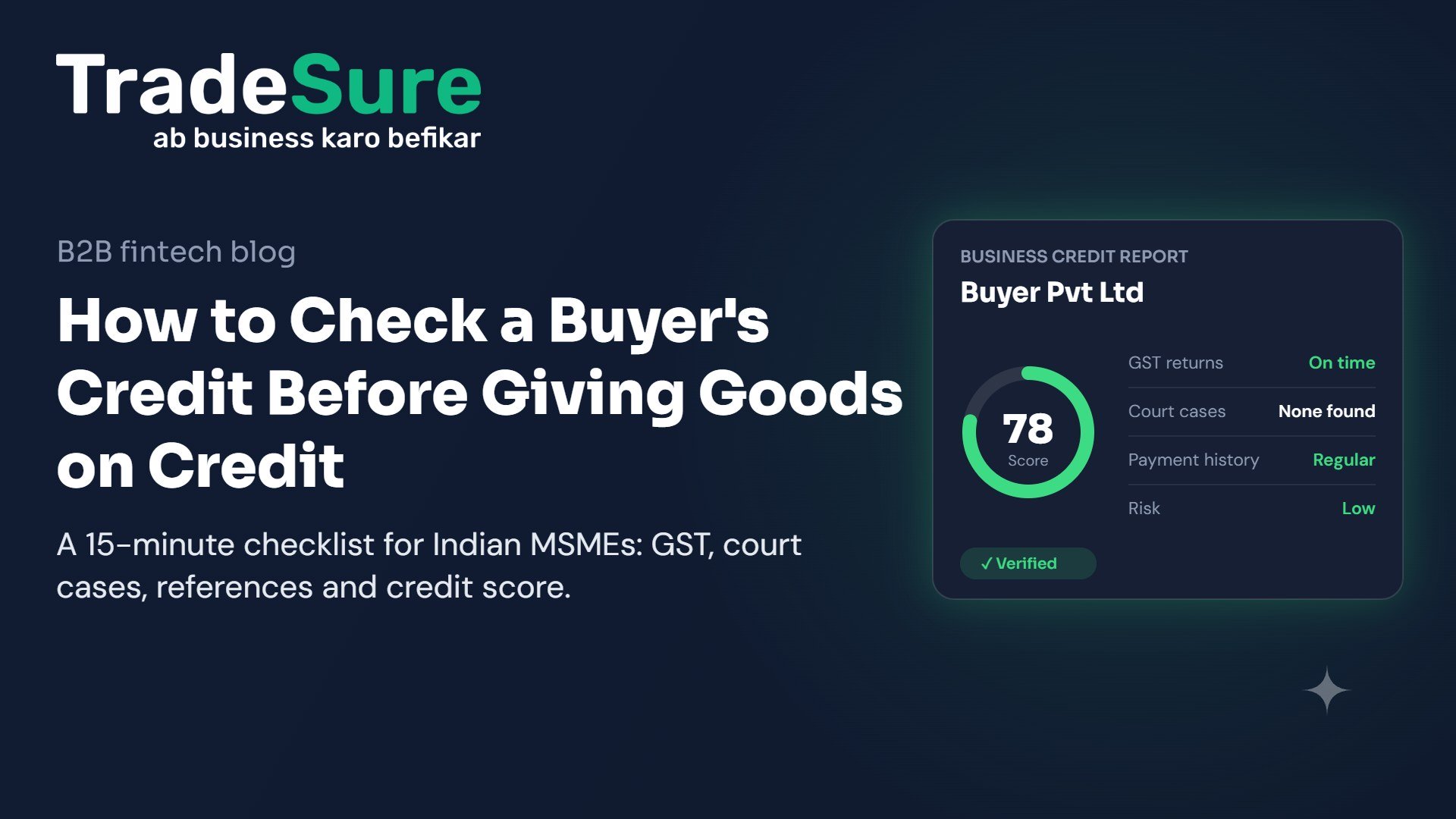
On TradeSure, you enter the buyer’s GST or PAN and get a single report with a TradeSure Score, turnover range, GST filing behaviour, court cases and KYC details like linked contacts and addresses. It takes a couple of minutes and saves you from doing steps 1 to 3 separately.
Step 5: Call two of their existing suppliers
This is the oldest trick in Indian trade and it still works. Ask the buyer for two or three suppliers they currently buy from. Then call them.
Ask simple questions:
- How long have you been supplying them?
- What credit period do you give, and do they stick to it?
- Have they ever disputed an invoice or asked for extra time?
If the buyer refuses to share any references, that’s an answer in itself.
Step 6: Decide the credit limit and terms
Once you’ve done the checks, put a number on it. A few rules that work well for most MSMEs:
- Start small. First order on advance or a short credit period. Increase the limit as they pay on time.
- Put the terms in writing. Credit period, interest on late payment and the due date should be on the invoice or in a simple agreement.
- Use security for big orders. A post-dated cheque, a bank guarantee or a letter of credit makes sense when the amount is large.
- Know your MSME rights. If you’re a micro or small enterprise registered on Udyam, buyers must pay within the agreed period, and that period can’t be more than 45 days. Mention your Udyam number on your invoices.
Step 7: Don’t stop checking after the first order
A buyer who was healthy last year might be in trouble now. Keep an eye out for slower payments, a sudden jump in order size, new GST filing gaps or the owner becoming hard to reach.
And set up reminders before the due date, not after it. A polite call three days before payment is due prevents more defaults than ten angry calls after. TradeSure’s AI reminder calls can do this automatically in your buyer’s language. We’ve compared it with other options in our post on the best payment recovery apps for Indian MSMEs.
Quick checklist
| Check | Where | Cost |
|---|---|---|
| GST status and filing history | GST portal (Search Taxpayer) | Free |
| Company status, directors, loans | MCA portal | Free for basic details |
| Court cases and cheque bounces | eCourts services | Free |
| Commercial credit report | CIBIL, CRIF, Experian, Equifax | Paid |
| All-in-one B2B report | TradeSure | Paid per report |
| Trade references | Phone calls to their suppliers | Free |
Frequently asked questions
How can I check a company’s details using its GST number?
Enter the GSTIN in the Search Taxpayer tool on the GST portal. You’ll see the legal name, address, registration date, status and return filing history. Platforms like TradeSure also show turnover range and linked details from the same GST number.
Can I check a business’s CIBIL score?
Yes. TransUnion CIBIL issues commercial credit reports and a CMR rank for businesses. Other bureaus like CRIF High Mark, Experian and Equifax offer similar reports.
What credit period should I give a new buyer?
Keep it short for the first few orders, or ask for an advance. Increase the credit period and limit only after they’ve paid on time a few times.
Is the 45-day payment rule mandatory for buyers?
For supplies from micro and small enterprises registered on Udyam, yes. Under the MSMED Act, the buyer has to pay within the agreed period, which can’t exceed 45 days. Late payments attract compound interest at three times the RBI bank rate.
What are the red flags of a risky B2B buyer?
A suspended or very new GSTIN, missed GST returns, cheque bounce cases, refusal to share supplier references, and pressure for a large first order on long credit.
Written by Priya Mehta, Co-Founder & CMO at TradeSure. Want to check a buyer right now? Pull a credit report on TradeSure or message us on WhatsApp at +91 93285 13529.