
MSME Samadhaan: How to Recover Delayed Payments (2026 Guide)
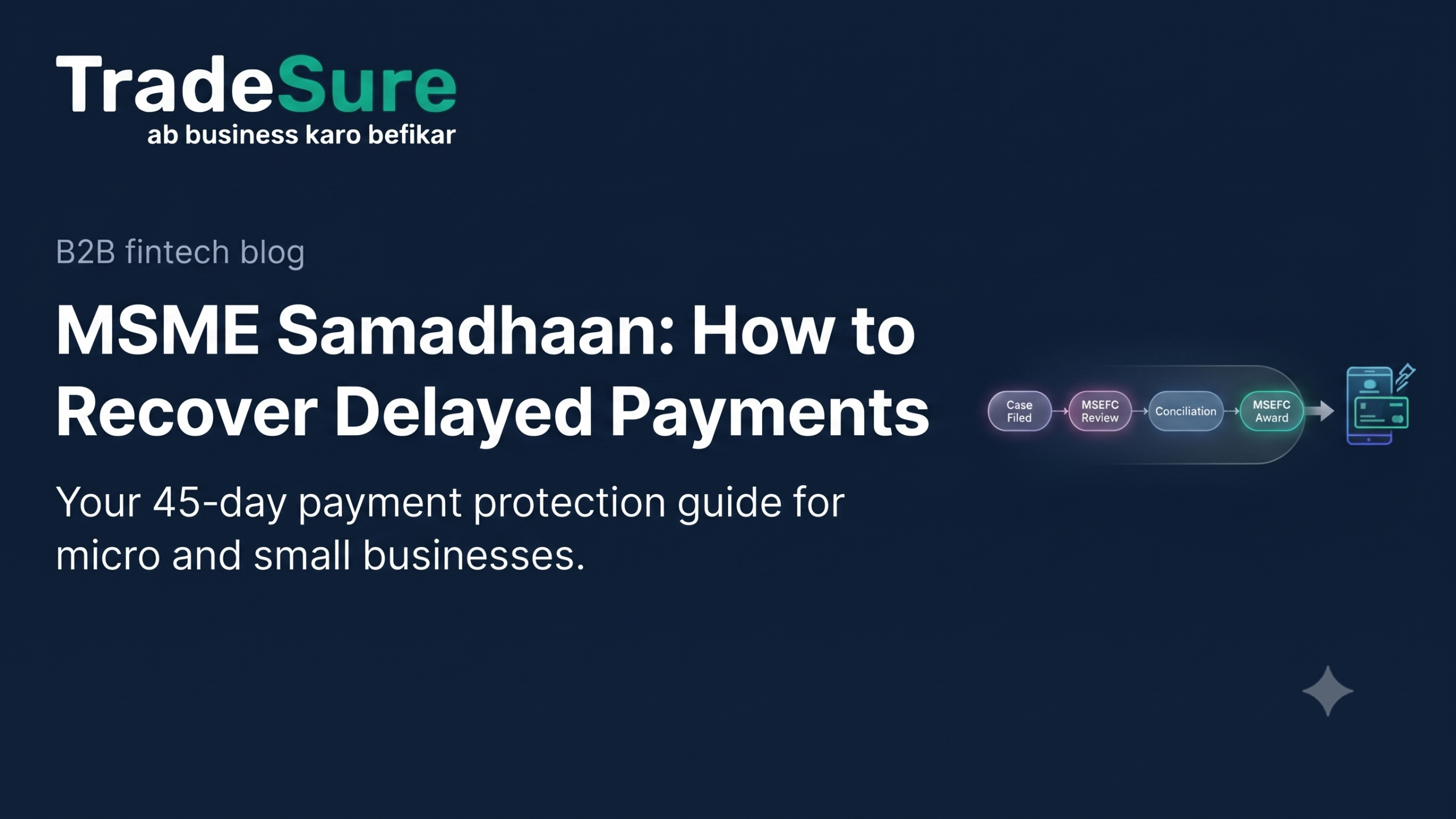
Quick answer: MSME Samadhaan is the Government of India’s online Delayed Payment Monitoring System. If a buyer has not paid a Udyam-registered micro or small enterprise within 45 days of accepting goods or services, the supplier can file a case before the state’s Micro and Small Enterprise Facilitation Council (MSEFC). The buyer then owes the dues plus compound interest at three times the RBI bank rate. New applications are now filed on the MSME ODR Portal.
You deliver the goods. You raise the invoice. And then you wait. 60 days, 90 days, sometimes 180. Meanwhile your own suppliers, salaries and GST still have to be paid on time.
If this sounds familiar, you are not alone. Micro and small enterprises have filed 2,56,892 applications on MSME Samadhaan so far, and cases filed with state councils since 30 October 2017 involve ₹29,470.58 crore in payable amounts. The good news: the law is clearly on your side. This guide explains exactly how to use it.
What is MSME Samadhaan?
MSME Samadhaan is an online portal run by the Ministry of Micro, Small and Medium Enterprises. It lets a micro or small supplier file a delayed payment complaint against a buyer before the MSEFC of their state or UT. It was launched on 30 October 2017.
Cases filed on the portal are visible not only to the MSEFC, but also to central ministries, departments, CPSEs and state governments. That visibility puts real pressure on large buyers to settle.
Important update for 2026: The MSME Samadhaan website now asks that all new delayed payment applications be filed on the MSME ODR (Online Dispute Resolution) Portal at odr.msme.gov.in. Samadhaan is still where you check the status of older cases and see national statistics.
What does the MSMED Act, 2006 say about delayed payments?
Sections 15 to 24 of the Micro, Small and Medium Enterprises Development (MSMED) Act, 2006 protect micro and small suppliers. Here are the rules every business owner should know:
- 45-day payment limit (Section 15): The buyer must pay by the agreed date, and the agreed period cannot exceed 45 days from acceptance of goods or services. If there is no written agreement, payment is due within 15 days.
- Penal interest (Section 16): If the buyer pays late, they owe compound interest with monthly rests at three times the bank rate notified by RBI.
- 90-day decision (Section 18): Every reference to the MSEFC is meant to be decided within 90 days.
- 75% pre-deposit (Section 19): A buyer who wants to challenge the MSEFC award in court must first deposit 75% of the award amount.
- Councils everywhere: All 37 states and UTs have constituted MSEFCs, usually chaired by the state’s Director of Industries.
There is a tax angle too. Under Section 43B(h) of the Income Tax Act, a buyer can claim a deduction for dues to micro and small enterprises only in the year they are actually paid, if they pay beyond the MSMED Act time limit. So late payment now hurts the buyer’s tax bill as well.
Who can file a delayed payment case?
Any micro or small enterprise with a valid Udyam Registration can apply. Keep these points in mind:
- You must be the supplier of goods or services. The complaint is filed against the buyer.
- Medium enterprises are not covered by these delayed payment provisions.
- Your Udyam Registration should be in place before the supply. Councils often reject claims where it is missing or invalid.
Rejections are common. MSEFCs have rejected 81,525 applications so far, more than three times the 24,240 applications settled mutually. Getting eligibility and paperwork right is half the battle.
How to file a delayed payment case: step by step
- Check eligibility. Confirm your Udyam Registration is valid and that more than 45 days have passed since the buyer accepted your goods or services.
- Gather your documents. Keep ready the purchase order or agreement, invoices, delivery challans or proof of acceptance, your ledger statement, and copies of reminders or emails sent to the buyer.
- Go to the MSME ODR Portal. New applications are filed at odr.msme.gov.in, as directed on the Samadhaan site.
- Enter buyer and invoice details. Add the buyer’s name, address and GSTIN, and list each unpaid invoice with its date and amount.
- Upload evidence and submit. Attach your documents and note your application number.
- Track your case. Follow the status online and respond quickly to any notice from the MSEFC.
What happens after you file?
The process moves in clear stages:
- MSEFC review: The council checks your application. Incomplete or ineligible cases are rejected at this stage.
- Conciliation: The council tries to get you and the buyer to settle. If the buyer pays, the case closes.
- Arbitration: If conciliation fails, the MSEFC takes up the dispute for arbitration itself or refers it to an institution.
- MSEFC award: The council passes an award for your dues plus MSMED Act interest. The buyer can appeal only after depositing 75% of the award.
So far, MSEFCs have disposed of 63,016 cases involving ₹9,040.80 crore, and 44,691 cases are still under consideration. In practice, many councils take longer than 90 days, so file early and keep your records clean.
Common mistakes that get MSME Samadhaan cases rejected
- Filing without a valid Udyam Registration, or registering only after the supply.
- No proof that the buyer accepted the goods or services.
- Claimed amounts that don’t match your invoices or ledger.
- No written record of payment follow-ups with the buyer.
How to prevent delayed payments in the first place
The best case is the one you never have to file. Three habits make the biggest difference:
- Check your buyer before you supply. Look at their GST filing history and payment track record. Here’s our guide on how to check a buyer’s credit in India.
- Put payment terms in writing. Mention the 45-day limit and MSMED Act interest on every invoice and purchase order.
- Follow up early and consistently. Most delays turn into disputes because reminders stop after the first call. Compare options in our list of the best payment recovery apps for Indian MSMEs.
How TradeSure helps you get paid on time
TradeSure is India’s first Business Risk Intelligence Platform, built for Indian MSMEs. Check a buyer’s TradeSure Trust Score and GST intelligence before you extend credit. Then let AI payment reminder calls follow up with slow payers in their language, automatically. If a buyer still doesn’t pay, your reminder history gives you a stronger paper trail for the MSEFC.
Ab business karo befikar. Start free on TradeSure.
Frequently asked questions about MSME Samadhaan
What is MSME Samadhaan?
MSME Samadhaan is the Ministry of MSME’s online Delayed Payment Monitoring System. It lets Udyam-registered micro and small suppliers file delayed payment complaints against buyers before their state’s MSE Facilitation Council (MSEFC).
Where do I file a new delayed payment case in 2026?
New delayed payment applications are now filed on the MSME ODR Portal at odr.msme.gov.in. The MSME Samadhaan site is used to check the status of older cases.
How many days does a buyer have to pay an MSME?
Under the MSMED Act, 2006, a buyer must pay a micro or small supplier within the agreed period, which cannot exceed 45 days from acceptance of goods or services. Without a written agreement, payment is due within 15 days.
How much interest can an MSME claim on a delayed payment?
The buyer owes compound interest with monthly rests at three times the bank rate notified by the RBI, from the due date until the payment is made.
Can a medium enterprise file on MSME Samadhaan?
No. The delayed payment provisions of the MSMED Act cover only micro and small enterprises with a valid Udyam Registration.
How long does an MSEFC take to decide a case?
The MSMED Act sets 90 days for the MSEFC to decide a reference. In practice, many cases take longer, depending on the state council’s workload.
Can the buyer appeal against the MSEFC award?
Yes, but the buyer must first deposit 75% of the award amount with the court before the appeal is heard.
Written by Priya Mehta, Co-Founder & CMO at TradeSure. Figures are from the MSME Samadhaan portal as of October 2026. This article is for general information and is not legal advice. Want help chasing a delayed payment? Try TradeSure or message us on WhatsApp at +91 93285 13529.