
Best Payment Recovery Apps for Indian MSMEs in 2026 (Honest Comparison)
Every few weeks a business owner messages us on WhatsApp with some version of the same question: “Which app should I use to get my money back?”
It sounds like a simple question. It isn’t. A kirana shop chasing ₹2,000 of udhaar, a coaching centre chasing monthly fees and a steel trader waiting on ₹8 lakh from a distributor have very different problems. An app that’s perfect for one of them is useless for the others.
So instead of telling you “use ours”, here’s how we’d actually think about it. Yes, TradeSure is on the list. We’ve tried to be fair to everyone else too, including the tools we compete with.
The short answer
- Kirana shops and small retailers with daily customer udhaar: Khatabook or OkCredit.
- Freelancers and agencies sending a handful of invoices a month: Zoho Invoice or KindDue.
- Schools, coaching centres and anyone with fixed monthly fees: FastFee.
- Banks, NBFCs and large lenders: Credgenics.
- Wholesalers, distributors and manufacturers who sell goods on credit to other businesses: TradeSure, with CreditQ worth a look if you mainly want to report defaulters.
Now the longer version.
What actually gets a payment recovered?
Before comparing apps, it helps to know why money gets stuck in the first place. In B2B trade it’s usually one of three things:
- You gave credit to the wrong party. No GST check, no history check, just trust. This is the most expensive mistake and no reminder app can fix it later.
- Nobody followed up on time. The due date passed, you were busy, and by the time someone called it was day 75.
- The follow-up was easy to ignore. A WhatsApp message gets “seen” and nothing more. A phone call in the buyer’s own language is much harder to brush off.
Keep these three in mind while reading the rest. The right tool is the one that fixes the problem you actually have.
1. Khatabook and OkCredit: for shops tracking daily udhaar
These two made the digital bahi khata normal across India. You record what each customer owes, and the app can send them a reminder message with a payment link.
Good at: very simple, free to start, works for a shopkeeper who has never used business software.
Not built for: checking whether a new business buyer is safe to give credit to, or chasing large B2B invoices where a polite SMS isn’t enough.
2. Zoho Invoice: for clean, professional invoicing
Zoho Invoice is free GST invoicing software. You can set up automatic payment reminders and send invoices over email or WhatsApp. If you’re a freelancer or a small agency, it does the job well.
Good at: professional invoices, client portals, it’s part of the wider Zoho family if you grow into their accounting tools.
Not built for: buyer risk checks, or businesses whose customers don’t respond to emails at all.
3. KindDue: for freelancers and agencies
KindDue focuses on invoice reminders that escalate step by step over WhatsApp, email and SMS, with UPI links and QR codes so the client can pay in one tap. They don’t take a commission on what you collect.
Good at: written follow-ups that get firmer over time without you having to send the awkward message yourself.
Not built for: traders and distributors with hundreds of parties, or buyers who simply don’t read messages.
4. FastFee: for schools, coaching and recurring fees
FastFee is built around recurring collections. It uses UPI AutoPay mandates so the fee gets debited automatically, plus WhatsApp reminders and defaulter tracking.
Good at: fixed monthly amounts from the same people every month.
Not built for: B2B trade, where invoice amounts change every time and no buyer will sign an auto-debit mandate for you.
5. Credgenics: for banks and NBFCs
Credgenics is an enterprise collections platform used by lenders. It covers digital reminders, tele-calling, field agents and legal notices across large loan books.
Good at: scale, compliance and managing thousands of borrowers.
Not built for: an MSME owner who wants to sign up today with a mobile number and start chasing 40 parties.
6. CreditQ: for B2B credit reports and defaulter reporting
CreditQ is a business credit reporting platform. Sellers can report businesses that haven’t paid, and check a buyer’s record before giving credit. It’s a sensible option if your main goal is to put pressure on a defaulter through reporting.
Good at: B2B credit information and defaulter reporting.
Not built for: day-to-day follow-up calls on every invoice that’s coming due.
7. TradeSure: for B2B sellers who give goods on credit
This is the part where we talk about ourselves, so take it with that in mind.
We built TradeSure because our founder, Darshan, lost real money to bad debts in his own business. What he wanted didn’t exist in one place: something to check a buyer before giving credit, and something to keep calling them after.
So TradeSure does both:
- Before credit: pull a business credit report with a TradeSure Score, check GST filing history and turnover range, and run KYC on a new party.
- After credit: schedule AI voice calls that remind the buyer before the due date and follow up after it. The calls go out in 10 Indian languages, reach DND numbers too, and you can see who picked up and how long they listened.
We don’t collect money on your behalf. Your customer pays you directly, and we don’t take a cut.
Good at: wholesalers, distributors, manufacturers and traders in sectors like hardware, textiles, electricals, chemicals, tiles, pharma and packaging. More than 3,500 MSMEs are registered with us.
Not built for: recurring school fees, consumer loans, or a shop that only needs a digital khata. For those, the apps above are a better fit.
Side-by-side comparison
| App | Best for | Main way it recovers money | Checks the buyer before credit? |
|---|---|---|---|
| Khatabook / OkCredit | Retail shops | SMS/WhatsApp reminders with payment link | No |
| Zoho Invoice | Freelancers, small firms | Automated email and WhatsApp invoice reminders | No |
| KindDue | Freelancers, agencies | Step-by-step WhatsApp, email and SMS follow-ups | No |
| FastFee | Schools, coaching, subscriptions | UPI AutoPay and reminders | No |
| Credgenics | Banks and NBFCs | Tele-calling, field agents, legal workflows | Lender-side tools |
| CreditQ | B2B sellers | Defaulter reporting and settlement | Yes |
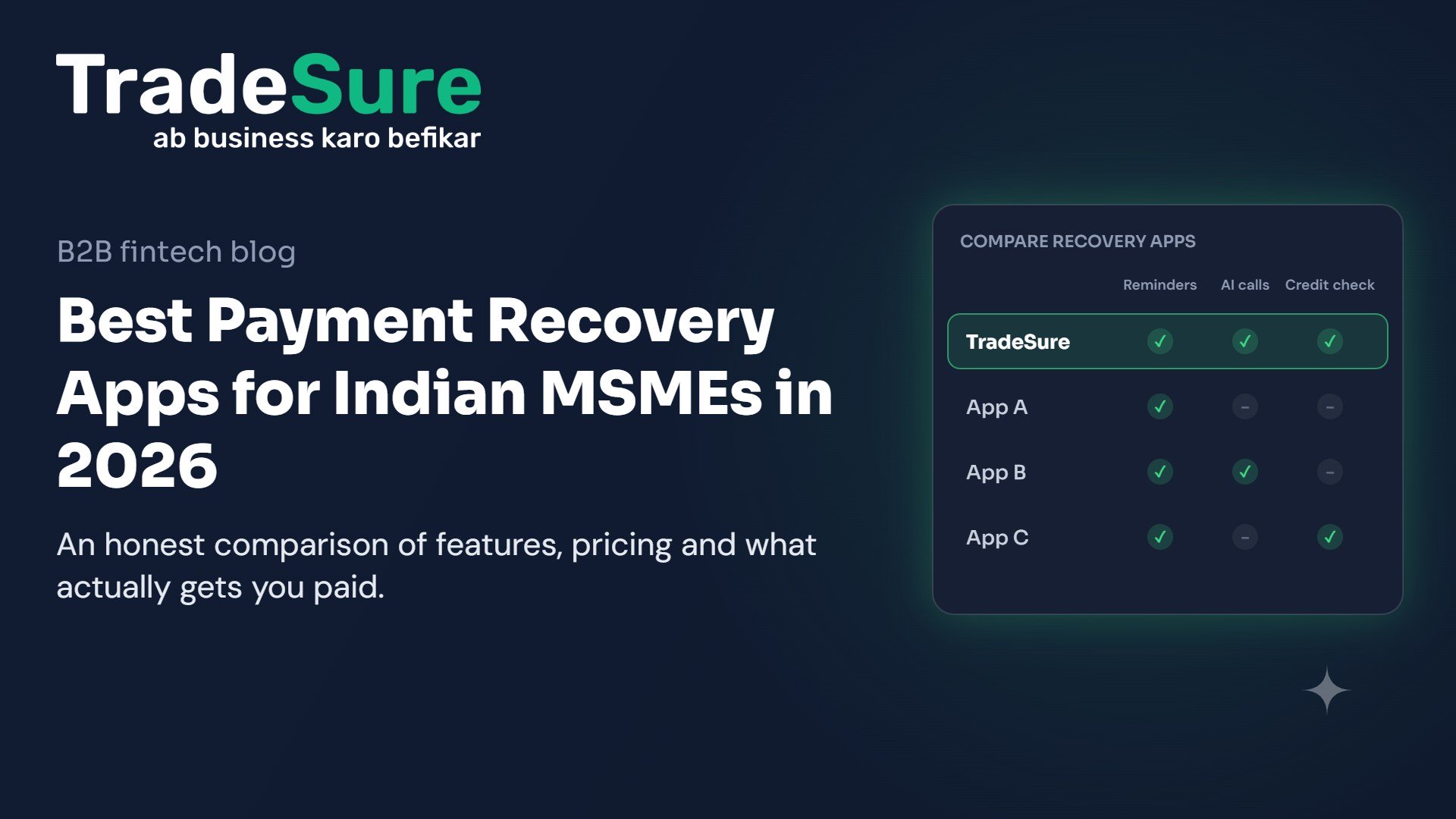
| TradeSure | B2B sellers, traders, manufacturers | AI voice calls in 10 languages | Yes (credit report, GST, KYC) |
How to choose in two minutes
Ask yourself three questions:
- Who owes me money? Consumers, students, borrowers or other businesses? That alone removes half the list.
- Is the amount the same every month? If yes, auto-debit tools like FastFee make sense. If every invoice is different, they don’t.
- Do my customers actually read messages? In a lot of Indian B2B trade, they don’t. A call in Gujarati or Hindi gets a response a WhatsApp text never will.
And whatever you pick, check new buyers before you ship. Recovering money is always harder than not losing it. We wrote a full guide on how to check a buyer’s credit in India before giving goods on credit.
Frequently asked questions
Which is the best payment recovery app in India?
It depends on who owes you. For retail udhaar, Khatabook or OkCredit. For freelancers, Zoho Invoice or KindDue. For recurring fees, FastFee. For lenders, Credgenics. For B2B sellers who give goods on credit to other businesses, TradeSure combines buyer credit checks with AI reminder calls.
Is there a free app to send payment reminders?
Yes. Khatabook, OkCredit and Zoho Invoice all have free options for sending reminders. TradeSure lets you sign up free and pay only for the reports and calls you use.
Do AI reminder calls actually work better than WhatsApp messages?
For many B2B buyers, yes. Messages are easy to ignore. A call in the buyer’s own language is harder to skip, and you get a record of whether they picked up and how long they listened.
Does a payment recovery app collect the money for me?
Most don’t. With TradeSure, Zoho Invoice, KindDue and Khatabook, the customer pays you directly. Recovery agencies and some enterprise platforms work differently, so check before signing up.
What can an MSME do legally if a buyer doesn’t pay in 45 days?
If you’re a micro or small enterprise registered on Udyam, the MSMED Act says buyers must pay within the agreed period, capped at 45 days. After that, compound interest at three times the RBI bank rate applies, and you can file a case with the MSME Facilitation Council through the MSME Samadhaan portal.
Written by Priya Mehta, Co-Founder & CMO at TradeSure. Want to see how AI reminder calls would work for your parties? Start free on TradeSure or message us on WhatsApp at +91 93285 13529.